FPGEE Exam 2026: Eligibility, Syllabus, Fees & 6-Month Study Plan
Last verified: July 2026
Most FPGEE guides give you a topic list and wish you luck.
That is not a study plan. A study plan tells you how many hours go to each subject and why – and the FPGEE tells you exactly that, if you read the official blueprint.
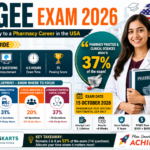
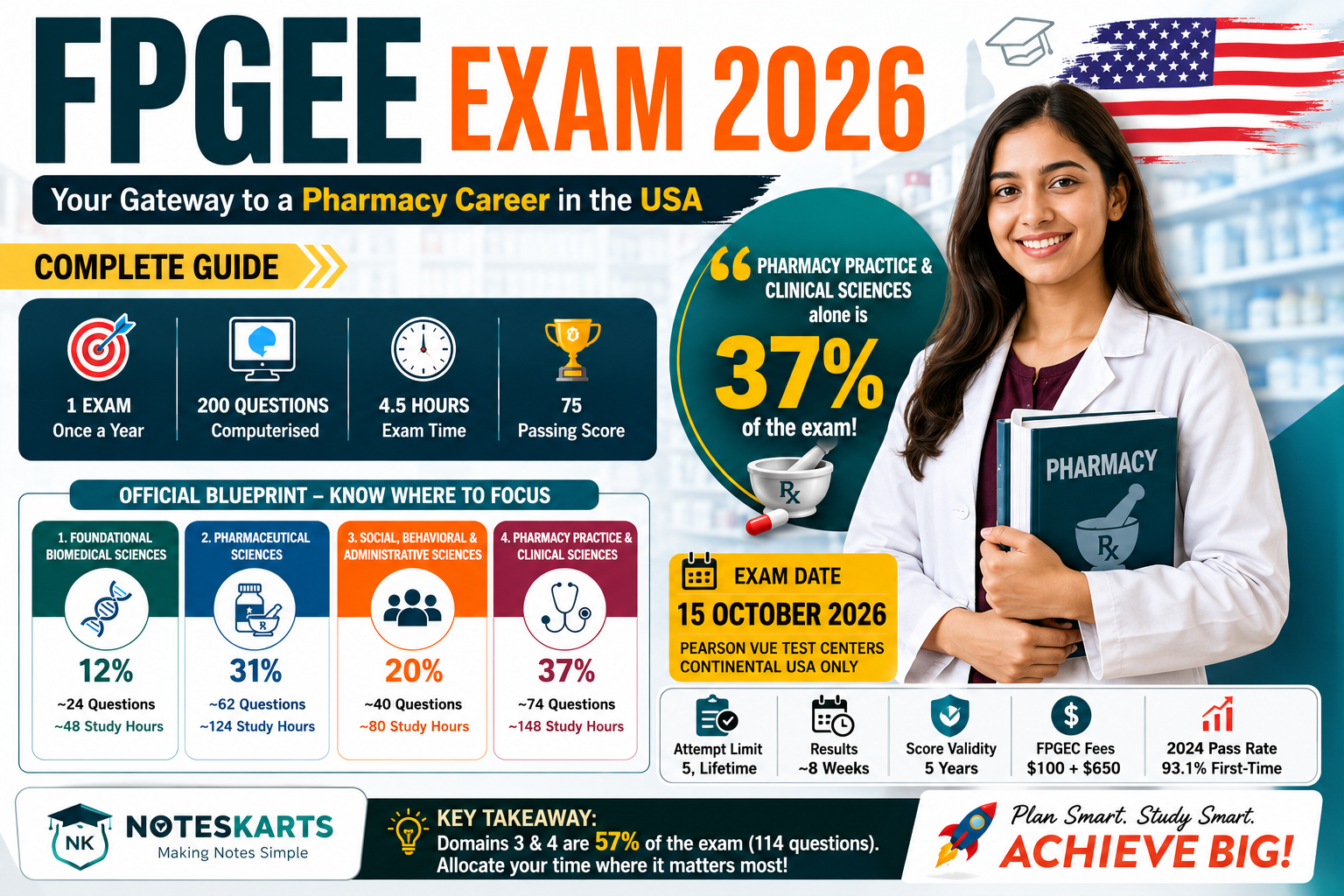
Here is the fact that should reshape your preparation: Pharmacy Practice and Clinical Sciences alone is 37% of the exam. Foundational Biomedical Sciences is 12%. If you are studying anatomy and biochemistry the way you did for B.Pharm, you are spending your best hours on the smallest section.
This guide covers eligibility, the official 2026 blueprint with exact question counts, real fees, honest pass rates, and a 6-month plan built for someone with a full-time job.
Quick facts: FPGEE 2026
| Item | Detail |
| Exam date | 15 October 2026 (held once per year) |
| Where | Pearson VUE test sites, continental USA only |
| Questions | 200, computerised, fixed form |
| Exam time | 4.5 hours (5.5 hours total seat time) |
| Passing score | 75 (scaled, not a percentage) |
| Attempt limit | 5, lifetime |
| Results | ~8 weeks, in your NABP e-Profile |
| Score validity | 5 years |
| FPGEC fees | $100 application + $650 evaluation |
| 2024 pass rate | 93.1% first-time |
Eligibility: check this before you spend anything
Three requirements. All three must be met – there is no partial credit.
- Graduate from a recognised or accredited school of pharmacy in a non-US country or jurisdiction.
- Curriculum length: if you received your pharmacy degree before 1 January 2003, a minimum 4-year curriculum. If you graduated on or after 1 January 2003, at least a 5-year pharmacy program at the time of graduation.
- An unrestricted pharmacy licence or registration, meeting the licensing requirements of the country where you obtained it.
The 5-year rule is the wall. A standard Indian B.Pharm is four years. If you graduated after 2003 with a 4-year B.Pharm alone, you do not clear this. An ECE credential evaluation is the only way to know where your specific qualification stands – not a forum, not a consultant, not this article. (Full breakdown of your options: see our guide on becoming a pharmacist in the USA from India.)
Two deadlines that catch people:
- You must pass the TOEFL iBT before you can be accepted for the FPGEE. NABP recommends preparing and taking the TOEFL before you even submit your FPGEC application.
- FPGEC applications are only valid for 2 years. Once accepted, you have 2 years to take and pass the FPGEE from your acceptance date. NABP states plainly that expiration dates are final and will not be extended for any reason.
The official FPGEE blueprint – and what it means for your hours
NABP publishes the exact weight of each content domain. This is the single most useful document in your preparation, and almost nobody reads it.
The outline was built by a panel of pharmacy educators who analysed content areas taught in US schools of pharmacy, drawing on the ACPE Standards 2025. They surveyed the heads of pharmacy curriculum at 127 US schools; 49 responded, rating the relevance of each content area. Those ratings set the domain weights.
Domain weights (of 200 scored questions)
| Content domain | Weight | Questions | Your study hours (of 400) |
| 1. Foundational Biomedical Sciences | 12% | ~24 | ~48 |
| 2. Pharmaceutical Sciences | 31% | ~62 | ~124 |
| 3. Social, Behavioral & Administrative Sciences | 20% | ~40 | ~80 |
| 4. Pharmacy Practice & Clinical Sciences | 37% | ~74 | ~148 |
Study hours column is our recommendation, weighted to the blueprint. The percentages are NABP’s.
Read the last two rows together. Domains 3 and 4 are 57% of the exam – 114 questions. These are the two domains Indian graduates are least prepared for, because Indian pharmacy curricula do not emphasise US health systems, US pharmacy law, pharmacoeconomics, or clinical decision-making the way US curricula do.
Meanwhile Domain 1 – anatomy, physiology, biochemistry, microbiology, immunology – is the domain Indian graduates know best, and it is worth 24 questions.
Most FPGEE failures are not knowledge failures. They are allocation failures.
What each domain actually covers
NABP’s content outline is copyrighted, so rather than reproduce it, here is a summary in plain terms – then download the official PDF from nabp.pharmacy and work from that. It is free.
Domain 1 – Foundational Biomedical Sciences (12%). Anatomy and physiology, biochemistry, medical microbiology, immunology, and the pathophysiological basis of disease. Familiar territory from B.Pharm.
Domain 2 – Pharmaceutical Sciences (31%). Pharmaceutical calculations, medicinal chemistry, pharmacology and toxicology, pharmaceutics and biopharmaceutics, pharmacokinetics, pharmacogenomics, and extemporaneous compounding. Note the compounding sub-domain references USP Chapters 795, 797 and 800 – US standards you have probably never studied. Learn them.
Domain 3 – Social, Behavioral & Administrative Sciences (20%). US pharmacy law and ethics, the US health care system and how it is financed, pharmacoeconomics, population-based care and public health, practice management, professional communication, biostatistics and research methods, and the behavioural side of practice including adherence and cultural awareness. This domain is almost entirely new material for an Indian graduate.
Domain 4 – Pharmacy Practice & Clinical Sciences (37%). Clinical pathophysiology applied to treatment, data collection and assessment, patient-care decision making, patient safety, disease prevention, personalised medicine, evidence-based practice, and self-care including natural products. The biggest domain, and the most clinical.
The pattern: 68% of the exam (Domains 2 and 4) is applied – it asks what you would do, not what you memorised. Indian exams reward recall. The FPGEE rewards application. Adjust how you study, not just what.
[AFFILIATE – FPGEE review books / question bank]
FPGEE pass rates: the honest numbers
NABP publishes five-year pass rates. Here they are:
| Administration year | First-time takers | All takers |
| 2021 | 77.5% | 67.8% |
| 2022 | 90.2% | 84.7% |
| 2023 | 89.3% | 86.3% |
| 2024 | 93.1% | 91.1% |
Source: NABP Five-Year FPGEE Pass Rates (2021-2025). Check nabp.pharmacy for the 2025 figure.
Two things to take from this table.
First, the pass rate is high and rising – 93.1% for first-time takers in 2024. The FPGEE is not the impossible exam some forums make it out to be. Prepared candidates pass.
Second, look at the gap between first-time and all-time takers, and how it has narrowed. In 2021 the gap was nearly 10 points; by 2024 it was 2. But note what happened in 2021: it was the first year after the rule that candidates must pass the TOEFL before taking the FPGEE, which took effect on 1 January 2020. The English gate raised the floor.
The practical read: if you clear the TOEFL and prepare to the blueprint, the odds are strongly with you. The exam is not what fails people. The eligibility gate, the paperwork, and the annual schedule are.
Fees: the exact 2026 numbers
NABP now states the FPGEC fees explicitly, which settles a lot of contradictory blog posts:
| Fee | Amount | Notes |
| FPGEC application fee | $100 | Non-refundable |
| Document evaluation fee | $650 | Non-refundable |
| FPGEC total | $750 | Both fees non-refundable under NABP’s refund policy |
| FPGEE exam fee | ~$650 – $750 | Confirm in the current Bulletin |
| FPGEE retake | ~$750 – $850 | Full fee each attempt |
| TOEFL iBT | ~$200 – $250 | 15% off with code NABPTOEFL |
| ECE evaluation | ~$150 – $300 | Paid separately to ECE |
Both FPGEC fees are non-refundable. If your credentials are found ineligible after evaluation, that $750 is gone. This is precisely why the ECE evaluation comes first – it is the cheap way to find out.
Add the flight, US visitor visa, and accommodation for exam week – the FPGEE is administered only in the continental US – and the realistic first-attempt total lands around $4,000-$6,000 (roughly Rs 3.4L-5.2L at Rs 86).
2026 dates and one change nobody has updated
| Date | What happens |
| 15 May 2026 | Registration opens |
| 1 Sept 2026 | Deadline to purchase the FPGEE (by 5 PM CST) |
| 15 Sept 2026 | Deadline to submit a name change |
| 8 Oct 2026 | Deadline to schedule or cancel at Pearson |
| 15 Oct 2026 | FPGEE exam day |
| ~Dec 2026 | Scores appear in your NABP e-Profile |
The change: as of 1 April 2026, candidates no longer receive an FPGEE Identification Card (FIC). Older guides – and there are many – still tell you to bring your FIC to the test centre or forfeit your fees. That instruction is now obsolete. Check the current Candidate Application Bulletin for what test day requires instead.
What has not changed: your primary ID must exactly match your name in your e-Profile and on your Authorization to Test. Mismatch and you forfeit the fee – and the year.
Purchase deadlines run on NABP business hours, 9 AM to 5 PM CST, regardless of where you are buying from. If you are in India, that is roughly 7:30 PM to 3:30 AM IST. Do not leave it to the last evening.
The 6-month study plan (for people with jobs)
This plan assumes ~15 hours per week: 2 hours on weekday evenings, 5 hours across the weekend. Six months gives you roughly 390-400 hours. Hours are allocated by blueprint weight, not by comfort.
Working backwards from 15 October 2026, month 1 starts in mid-April.
Month 1-2: Domain 2 – Pharmaceutical Sciences (~124 hrs)
- Start here, not with biology. It is 31% of the exam and it is the domain where your Indian training transfers best – which means fast wins that build momentum.
- Pharmaceutical calculations first. Every calculation question is a guaranteed mark if your method is solid. Drill until you are accurate under time pressure, not just accurate.
- Then pharmacology, medicinal chemistry, pharmacokinetics, biopharmaceutics.
- Budget a full week for USP <795>, <797> and <800> compounding standards. These are US-specific and you almost certainly have not studied them.
Month 3: Domain 3 – Social, Behavioral & Administrative (~80 hrs)
- Treat this as a new subject, because it is. US pharmacy law, US health care financing, pharmacoeconomics, biostatistics.
- This is where Indian candidates lose marks quietly. You cannot reason your way to the answer – you either know how US health care is organised and financed, or you do not.
- Biostatistics and research methods are worth real marks and are learnable in weeks. Do not skip them.
Month 4-5: Domain 4 – Pharmacy Practice & Clinical Sciences (~148 hrs)
- The biggest domain at 37% – 74 questions. Give it the most time and your sharpest hours.
- Work disease-state by disease-state: pathophysiology, then guideline-based therapy, then monitoring.
- Use US clinical practice guidelines. Indian therapeutic conventions will actively cost you marks here.
- Slot Domain 1 (Foundational Biomedical, ~48 hrs) alongside this as revision. You already know most of it. 24 questions does not justify a dedicated month.
Month 6: Full-length practice and repair
- Take the Pre-FPGEE, the official practice exam. NABP is explicit that it is not a study guide – it exists to show you the question format and give a score estimate. Use it as a diagnostic, not a textbook.
- Download NABP’s official sample items to understand question formatting.
- Sit at least three full 4.5-hour timed papers. Stamina is a skill. 200 questions in 4.5 hours is 81 seconds per question, and nobody discovers their pacing problem on exam day and survives it.
- Rebuild weak areas from your practice results, weighted by blueprint – a gap in Domain 4 costs you three times what a gap in Domain 1 does.
The rule that decides whether this works
Score every study hour against the blueprint. Before you open a book, ask: which domain, and what percentage is it worth? If you cannot answer, you are not studying, you are reading. That distinction is the whole difference between 93.1% and the other 6.9%.
Frequently asked questions
Q: What is the FPGEE syllabus for 2026?
A: The FPGEE covers four domains: Foundational Biomedical Sciences (12%), Pharmaceutical Sciences (31%), Social, Behavioral and Administrative Sciences (20%), and Pharmacy Practice and Clinical Sciences (37%). The official content outline is free to download from nabp.pharmacy.
Q: How many questions are on the FPGEE?
A: 200 scored questions, delivered in a computerised fixed form. You get 4.5 hours; total seat time is 5.5 hours.
Q: What is the FPGEE passing score?
A: 75. This is a scaled score, not a percentage – answering 75% of questions correctly does not guarantee a pass.
Q: What is the FPGEE pass rate?
A: 93.1% for first-time takers in 2024, up from 77.5% in 2021, according to NABP’s five-year data. All-time taker rates were 91.1% in 2024.
Q: How much does the FPGEE cost?
A: The FPGEC application fee is $100 and the document evaluation fee is $650 – both non-refundable. The FPGEE exam fee is separate. Confirm all figures in the current Candidate Application Bulletin.
Q: When is the FPGEE 2026 exam?
A: 15 October 2026. Registration opened 15 May and the purchase deadline was 1 September 2026. It is held once a year.
Q: Can I take the FPGEE more than once?
A: Yes, up to 5 attempts – a lifetime limit. You must pass within the 2-year validity of your FPGEC application, and expiration dates are never extended.
Q: Do I still need the FPGEE Identification Card?
A: No. As of 1 April 2026, candidates no longer receive an FIC. Check the current Bulletin for test-day ID requirements.
Q: How long should I study for the FPGEE?
A: Six months at roughly 15 hours a week (~400 hours) is realistic for a working professional. Allocate those hours by blueprint weight, not by subject comfort.
Your next step
Download two free documents today, before you buy a single review book:
- The FPGEE Content Outline (nabp.pharmacy) – your blueprint. Print it. Tick topics off it.
- The FPGEC Candidate Application Bulletin – the only authority on fees, deadlines, and test-day rules. Everything else, including this article, is secondary.
Then build your hour allocation off the domain weights. Everything else is detail.
Blueprint weights, fees, dates, and pass rates in this guide were verified against NABP sources in July 2026. NABP updates requirements regularly – always confirm against the current Bulletin before paying any fee. This article is general information, not legal or immigration advice.
Related reading on Noteskarts
- How to Become a Pharmacist in USA from India: Complete 2026 Guide
- NAPLEX Preparation Guide 2026
- DHA Pharmacist Exam: The Faster, Cheaper Alternative to the US Route
- Pharmacist Salary in USA 2026: State-by-State